EN
EN



Engineering Foundations of Wind Resistance in Foldable Container Houses
High-Grade Steel Frame Design and Load Distribution Under High-Wind Stress
Foldable container homes get their strength against wind damage thanks to top quality steel frames, usually made from something called ASTM A588 Corten steel. These aren't your average building materials though. The way they work is pretty cool actually. Instead of just standing there like normal buildings do when strong winds hit, the steel frames in these containers move the force of the wind smoothly all the way down from the roof, through the walls, right into the ground itself. They accomplish this because of those super strong welds where everything connects together. What this means is no single spot on the house gets too much pressure at once, which prevents things from bending out of shape or breaking apart completely. Tests done by engineers show these containers can handle winds blowing over 150 miles per hour, which is really impressive considering most regular buildings start to struggle around half that speed. Some of the main things that make them so tough include...
- Cross-bracing: Diagonal steel members dissipate kinetic energy across the frame
- Corner reinforcements: Triple-thickness steel at pivot points resists rotational stress
- Aerodynamic profiling: Curved roof and wall transitions reduce uplift pressure by up to 40% compared to flat-surfaced alternatives
This integrated approach ensures structural integrity during hurricane-force gusts—particularly critical in coastal and tornado-prone regions.
How Folding Mechanisms Impact Structural Continuity—and What Modern Designs Fix
Early folding systems undermined wind resistance by introducing discontinuities at hinge lines—creating weak points vulnerable to racking and uplift. Today’s engineered solutions restore full structural continuity through three interdependent innovations:
- Interlocking seam technology: Precision-machined, gasket-sealed joints maintain rigidity when expanded
- Continuous flange connections: Laser-cut steel plates bridge fold lines without interrupting the load path
- Integrated shear panels: Triple-layered wall assemblies with structural sheathing resist lateral deformation
These foldable units have been tested according to the ASTM E330 standards for how well they resist wind loads, and what we find is pretty impressive. They actually hold up just as good, if not better than traditional rigid containers when it comes to resisting upward forces from strong winds. The Modular Building Institute published some numbers back in 2023 showing something remarkable too. When put through simulations of winds blowing at around 120 miles per hour (which translates to about 193 kilometers per hour), less than 2 percent of these units failed. That's a really low number considering what kind of force we're talking about here. So basically, today's folding technology doesn't mean sacrificing strength against storms just to gain portability anymore.
Real-World Wind Performance: Testing, Validation, and Case Evidence
FEMA-Validated Deployment: Foldable Container Houses in Hurricane Ian Recovery Zones
After Hurricane Ian hit in 2022, FEMA started setting up these foldable container homes throughout Florida's worst affected coastal areas. Places like Fort Myers Beach and Sanibel Island saw these temporary shelters going up fast. The containers followed all the ASCE 7 standards for anchoring and held up against winds blowing over 110 mph multiple times during the storm. They also weathered massive rainfalls and the rising water from the storm surge. When engineers checked them after everything settled down, they found no problems with joints coming apart, roofs lifting off, or frames bending out of shape in any units that had been properly set up. Getting each unit ready took less than three hours, which made a huge difference for families who lost their homes. What stood out most was how well these structures performed in actual hurricane conditions, proving once and for all that proper engineering can create truly resilient buildings even when faced with Mother Nature at her worst.
NIST and Wind Science Center Data on Foldable vs. Rigid Configurations at 120+ mph
Independent wind tunnel and full-scale testing conducted by the National Institute of Standards and Technology (NIST) and the University of Florida’s Wind Science Center compared foldable and rigid container house configurations under simulated Category 3 hurricane conditions (120 mph sustained winds). Results showed:
- Foldable units exhibited 2% deflection, attributable to interlocking corner castings and continuous flange integration
- Rigid designs experienced 5–7% greater stress concentration along load-bearing walls due to less optimized force redistribution
- Both types maintained structural integrity when anchored to reinforced concrete foundations designed per ASCE 7–22
Critically, uplift resistance was statistically equivalent between configurations—confirming that modern foldable designs preserve structural continuity without compromising aerodynamic stability.
Critical Integration: Anchoring, Sealing, and Foundation Systems for Wind Uplift Mitigation
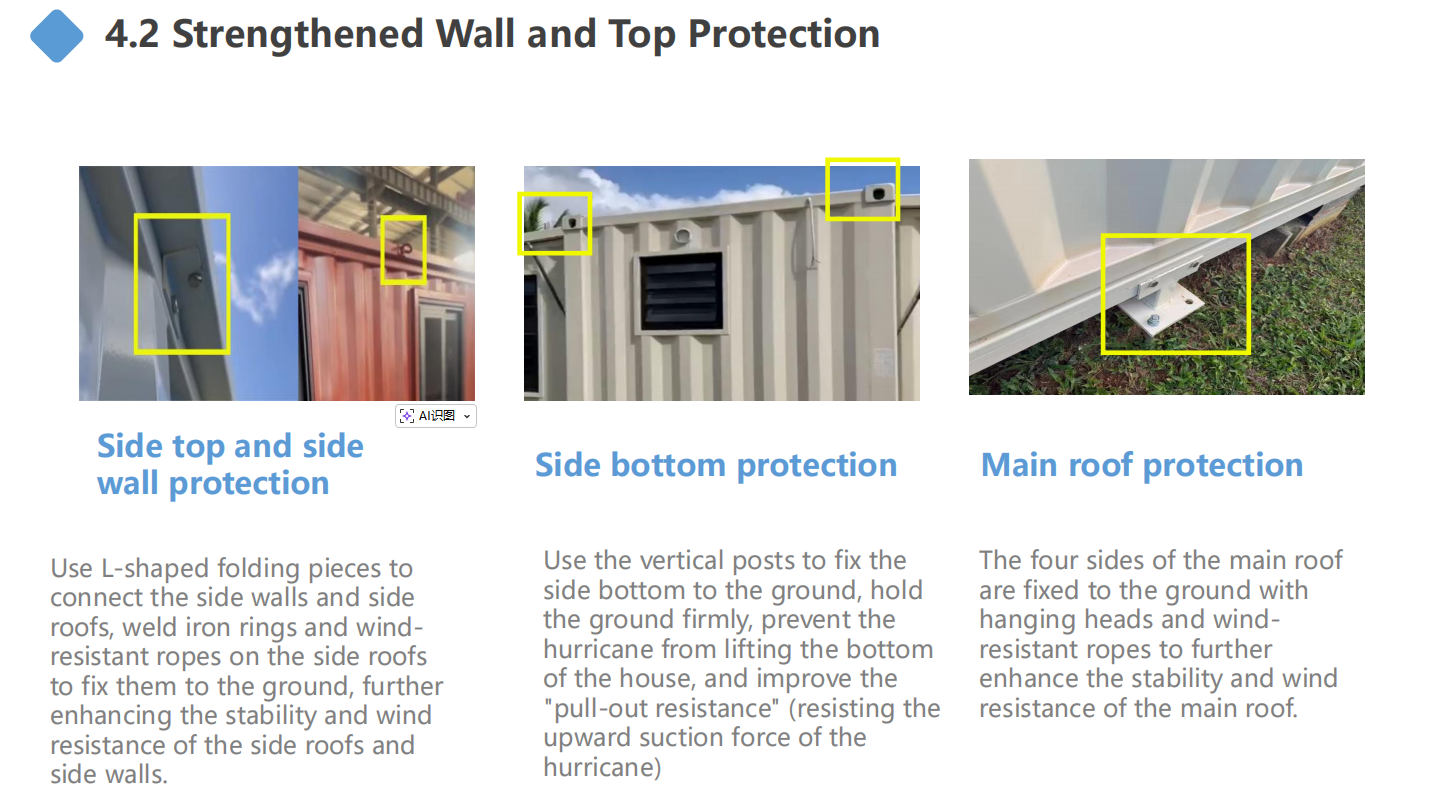
When it comes to standing up against strong winds, proper anchoring makes all the difference. What starts as just a standalone folding unit becomes something much more when properly anchored – essentially becoming part of the whole building structure on site. The real magic happens through those engineered connection points. We're talking about things like those super strong anchor bolts made for tension, corrosion resistant hurricane straps, and those metal plates built right into the base. All these components work together to create what engineers call a continuous load path running all the way from the top of the roof down to the foundation itself. For areas where hurricanes are common, builders need to make sure these systems can handle the force of wind blowing at around 150 miles per hour according to the latest guidelines in ASCE 7-22 standards.
Helical anchors—installed to depths exceeding 10 feet into stable soil strata—deliver superior pullout resistance over traditional concrete piers in sandy or loamy soils. Where soil bearing capacity is low, reinforced concrete footings or grade beams counteract overturning moments and prevent differential settlement.
Sealing works hand in hand with anchoring to tackle those pesky pressure differences inside buildings that cause roofs to lift off during storms. Things like compression gaskets, EPDM rubber seals, and those fancy multi-point latches on foldable sections all help block air from sneaking through gaps. Studies show this can cut down on upward force by roughly 30 percent when winds really pick up speed. When it comes to foundations, designers combine these sealing methods too. Raised pilings keep structures safe from floodwaters, and carefully planned drainage systems along the edges stop water from eating away at the ground near where anchors hold everything down. This helps maintain strong grip over time even after years of weather beating against the building.
All components must be specified, installed, and inspected in accordance with ASCE 7 wind load calculations tailored to site-specific exposure category, topography, and risk level.
Choosing a Wind-Resilient Foldable Container House: Key Specification Checklist
Selecting a foldable container house for high-wind regions demands rigorous technical due diligence—not marketing claims. Prioritize these engineering-verified specifications:
- Steel Frame Certification: Confirm use of ASTM A572 Grade 50 or ASTM A588 Grade 50 steel (minimum yield strength: 50 ksi) for all primary structural members. Require mill test reports—not just supplier statements.
- Anchoring System Compliance: Verify integrated ground anchors meet FEMA P-320 Safe Room Construction criteria for wind uplift resistance, including pullout testing data for local soil conditions.
- Sealing Effectiveness: Demand third-party air infiltration test reports (per ASTM E283) showing ⌠1% leakage at 120 mph equivalent pressure differential.
- Folding Mechanism Reinforcement: Require gusset plates at all pivot points and documented fatigue testing for ⌠500 expansion cycles without loss of joint stiffness or seal integrity.
- Certified Wind Rating: Insist on independent certification—such as Miami-Dade County Notice of Acceptance (NOA)—validating performance at 150 mph sustained winds and 180 mph 3-second gusts.
The strength of a foldable structure doesn't come automatically from its shape alone. Instead, it comes down to how well engineers actually integrate all the components. Take Hurricane Ian for example. We saw certain foldable units remain completely undamaged while traditional buildings around them were destroyed. Even some supposedly sturdy modular constructions didn't hold up as well. What makes the difference? It's not just about what materials are used or what type of building it is. The real key lies in proper certification and making sure the entire load path works together as intended. That kind of thoughtful engineering is what creates genuine resistance against extreme winds.
FAQ
What types of steel are used in foldable container houses for wind resistance?
Foldable container homes typically use high-grade ASTM A588 Corten steel for their frames due to its strength and durability under high-wind stresses.
How do modern foldable designs ensure wind resistance?
Modern designs restore structural continuity with interlocking seam technology, continuous flange connections, and integrated shear panels, which enhance their ability to withstand strong winds.
Have foldable container houses been tested for wind resistance?
Yes, they have been tested according to ASTM E330 standards and have shown to hold up well against high winds even compared to traditional rigid containers.
What role does anchoring play in these structures?
Proper anchoring is crucial as it integrates foldable units into the building structure ensuring stability against strong winds.
Are foldable container houses suitable for coastal areas prone to hurricanes?
Yes, when engineered and anchored properly, these houses have shown excellent resilience in hurricane conditions.
Table of Contents
- Engineering Foundations of Wind Resistance in Foldable Container Houses
- Real-World Wind Performance: Testing, Validation, and Case Evidence
- Critical Integration: Anchoring, Sealing, and Foundation Systems for Wind Uplift Mitigation
- Choosing a Wind-Resilient Foldable Container House: Key Specification Checklist
- FAQ