EN
EN



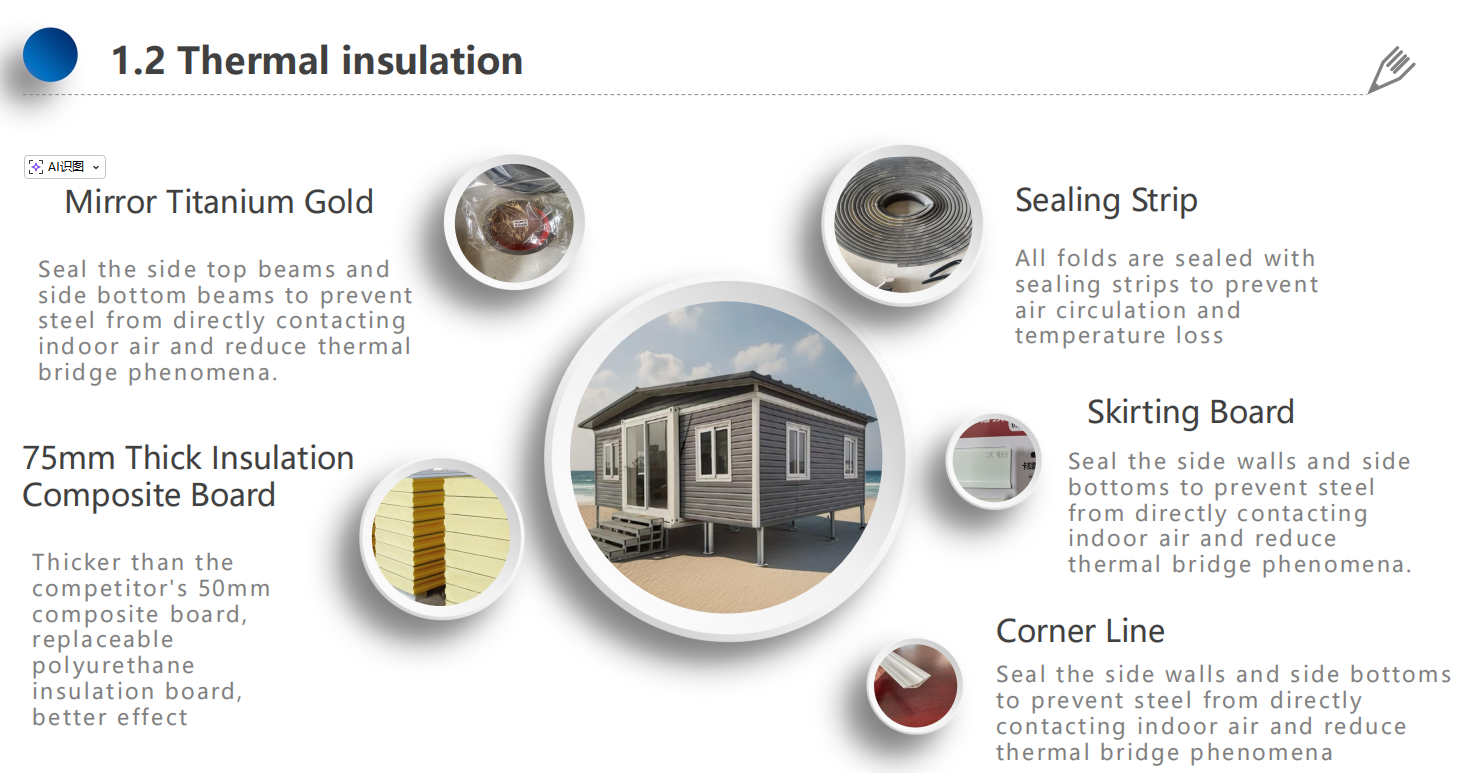
Choose High-Performance Insulation Materials for Your Prefabricated House
R-Value vs. U-Value: Selecting Optimal Materials Like SIPs, EPS Foam, and Closed-Cell Polyurethane
Understanding thermal metrics is critical for insulation performance. R-value measures resistance to heat flow—higher numbers block more heat transfer. U-value gauges heat loss—lower numbers indicate better insulation efficiency. Prioritize materials with high R-values and low U-values to minimize thermal bridging.
- Structural Insulated Panels (SIPs) achieve U-values as low as 0.040 W/m²K—outperforming traditional stick-built assemblies by 40–60%
- Expanded Polystyrene (EPS) Foam delivers R-4 per inch and remains a cost-effective choice for cavity fills and continuous exterior insulation
- Closed-Cell Polyurethane provides R-6.5–R-7 per inch and offers superior air-sealing properties, reducing convective losses at seams and penetrations
Leading manufacturers integrate these materials in factory-controlled environments, ensuring precision installation unattainable with on-site methods.
Climate-Appropriate R-Value Selection Using ASHRAE Zone Guidelines for Prefabricated House Envelopes
ASHRAE Standard 90.1’s climate zone framework defines minimum R-values for walls, roofs, and foundations—critical for optimizing thermal performance in prefabricated houses. For Zone 5 (e.g., New York):
- Walls require R-20–R-25
- Attics need R-49–R-60
- Floors should exceed R-30
In northern areas covering climate zones 6 through 8, buildings need around R-5 continuous exterior insulation just to stop moisture problems inside walls. Down south in zones 1 to 3, mixing regular insulation with reflective barriers works better for keeping things cool. According to what the US Department of Energy has found, matching insulation levels to these climate zones can cut down on both heating costs and air conditioning usage by roughly 15% to 30% for factory built homes and commercial spaces. Designers should definitely check what their local building codes say about ASHRAE 90.1 standards before finalizing plans since many regions have specific tweaks they require.
Eliminate Thermal Bridging in Prefabricated House Construction
Thermal bridging occurs when conductive structural elements—such as framing studs, metal connectors, or module junctions—bypass insulation layers, creating localized pathways for heat transfer. In prefabricated systems, it commonly appears at panel seams, window and door openings, and floor-to-wall interfaces.
Addressing Framing Interfaces and Junctions in Panelized and SIP-Based Prefabricated House Systems
To cut down on thermal bridging, builders should incorporate thermal breaks wherever different parts of the structure meet. The best approach includes installing continuous exterior insulation like those rigid mineral wool boards that stretch across joints, using non-conductive spacers between materials, and making sure cladding is attached with components that don't conduct heat. When working with structural insulated panels (SIPs), it's important to properly seal where the panels connect using compressible gaskets along with insulated splines for extra protection. Real world testing in buildings located within ASHRAE Climate Zone 5 has shown these methods can actually slash heat losses anywhere from 15% to nearly 27% when compared against regular construction techniques. That kind of improvement makes a real difference over time.
Achieving Airtightness: Blower Door Testing (Ø0.6 ACH50) as a Critical Validation Step
Good airtightness stops heat from escaping through convection and teams up with proper insulation to tackle thermal bridging issues. Builders should focus on several important steps when creating an airtight building envelope. First, apply those liquid membranes right where panels meet each other. Second, make sure to seal around all those pipes and wires going through walls with special tapes designed for this purpose. Don't forget about those electrical boxes either - they need to be sealed properly too. To check if everything was done correctly, most professionals will run a blower door test. The goal is to get below 0.6 air changes per hour at 50 Pascals pressure (that's what ACH50 means). Buildings that hit this standard typically see about 22% less work for heating and cooling systems. Plus, there's no risk of moisture problems in colder climates since we've eliminated the conditions that cause condensation inside walls.
Integrate Thermal Performance into the Full Prefabricated House Design Workflow
From Factory to Foundation: Coordinating Insulation, Air Sealing, and HVAC Sizing for Maximum Efficiency
Getting thermal efficiency sorted out needs to happen well before any factory work starts. When everything works together properly, insulation specs match up with air sealing methods and HVAC sizing gets figured out upfront. Structural panels end up with those continuous insulation layers built in, while pre-cut gaskets take care of those pesky gaps between joints. Once we know exactly what the building will need thermally, HVAC systems can be sized correctly instead of just throwing in something too big which wastes energy. Manufacturers who coordinate all these aspects tend to hit that sweet spot where their buildings stay under 0.6 ACH50 for air tightness after blowing doors test them out. And let's face it, nobody wants to spend extra money fixing problems after construction when it could have been avoided from day one.
Real-World Impact: DOE Data on Energy Savings and Comfort Gains in High-Performance Prefabricated Houses
According to research conducted by the U.S. Department of Energy, homes built using prefabrication methods with good thermal integration can cut down on heating and cooling expenses by anywhere from 30 to 50 percent compared to regular houses constructed on site. The benefits aren't just about saving money either. People actually experience better living conditions too. Temperatures inside these homes stay pretty much the same throughout the day, fluctuating only about 1 degree Celsius while traditional homes swing around 4 degrees. There's also far fewer cold spots and drafts making their way through walls and windows. Most importantly, residents report being much happier with their home's temperature control overall, with satisfaction levels jumping up around 40%. What all this shows is that when designers think about energy efficiency right from the start of construction, everyone ends up winning in the long run.
FAQ Section
What is the significance of R-value and U-value in insulation materials?
R-value measures how well a material resists heat flow, whereas U-value assesses heat loss. Higher R-values and lower U-values signify better insulation performance, crucial for effective thermal management.
How does climate affect the choice of insulation R-values in prefabricated houses?
Climate zones guide the selection of R-values for walls, roofs, and floors to optimize thermal performance. For instance, in cold northern zones, higher R-values are recommended to prevent moisture issues, while southern zones may benefit from additional reflective barriers for cooling.
What steps can reduce thermal bridging in prefabricated home construction?
Incorporating thermal breaks, continuous exterior insulation, non-conductive spacers, and properly sealing panel connections can minimize thermal bridging, enhancing the overall insulation efficiency and reducing heat loss.
Why is airtightness important, and how is it validated?
Airtightness prevents heat loss through convection and complements effective insulation. Blower door testing measures airtightness, targeting less than 0.6 air changes per hour at 50 Pascals pressure to ensure optimal performance.
How can integrating thermal performance into the design workflow benefit prefabricated house construction?
Coordinating insulation, air sealing, and HVAC sizing from the outset ensures efficient thermal management, results in accurate HVAC sizing, and minimizes complications post-construction, ultimately saving energy and reducing costs.